Key Takeaway: Oregon Trail, Carmen Sandiego, and Lemonade Stand worked because they really didn’t make it feel like you were learning. MECC built games that happened to teach geography, economics, and history without announcing it. That's why they're still remembered 40 years later, and most classroom software from the same era isn't.
Like most in my generation, I saw a computer at school before I had one in my home. My introduction to computer (if not console) gaming was through educational games on a classroom computer, such as the MECC (the Minnesota Educational Computing Consortium) classics Oregon Trail, Odell Lake, Lemonade Stand, Maya Quest, and Storybook Weaver. Many of these were also available on early consoles.
MECC was the PBS of early edutainment gaming, approved by many teachers, parents, and kids. I don’t remember much of the curriculum of late elementary school, but like any student of the 80s or 90s, I can tell you quite a bit about the perils of westward travel in the America of yore and the thrill of completing the float down the Columbia River to a new home in the Willamette Valley.
The Table of Contents
The hunting mini-game also provided a vivid context for later lessons on the depopulation of the Great Plains bison.
Similarly, Odell Lake was my first real invitation to grapple with the fish-eat-fish brutality of nature, where luck plays a role alongside strategy, as you can’t always tell which prey is actually bait.
Lemonade Stand, a text-based educational game I had forgotten for decades before researching this post, was certainly my introduction to microeconomics. It got me to set my lemonade prices relative to market costs and decide how much stock and advertising to invest in.
These were accompanied by games teaching the basics, starting with the 3 Rs (reading, writing, and arithmetic). Games like Reader Rabbit, Number Munchers, and Storybook Weaver genuinely made skill development fun, as did typing tutorials like Mavis Beacon Teaches Typing, whose fun race car minigame I still give silent thanks to when typing on a deadline today.
From the Classroom to the Adventure Game
Early educational games also led me to puzzle and adventure gaming.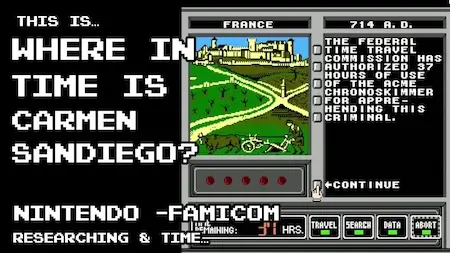
The Broderbund classic Where in the World is Carmen Sandiego? introduced generations of kids to geographical mystery-solving, while the Super Solvers (and later ClueFinders and Arthur) games brought adventure to 3Rs- and grade-level-based learning.
Sierra’s delightful Dr. Brain series, starting with The Castle of Dr. Brain, emphasized puzzle-adventure gameplay over school-curriculum-based structure. That’s probably why I store it more in the ‘fun’ category alongside Carmen Sandiego rather than in the ‘learning’ category in my brain.
These games provided me with a smooth segue into exploration adventure games like Adventure and Haunted House, action-adventures like The Legend of Zelda and Gauntlet, and point-and-click games like The Secret of Monkey Island and King’s Quest.
When the Big Brands Showed Up
Major entertainment and educational players entered the gaming edutainment arena, too, competing with the edutainment gaming greats mentioned above.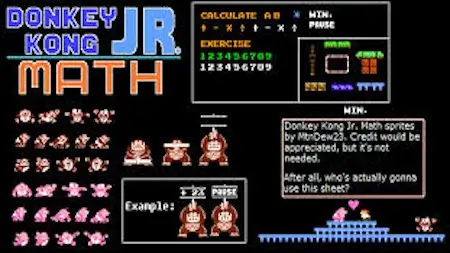
Nintendo produced Mario is Missing!, Donkey Kong Jr. Math, and Mario’s Time Machine for the edutainment space. Sesame Street put out Sesame Street 123 and Sesame Street ABC, while Fisher Price released pre-school/kindergarten-aimed games like Fisher Price: I Can Remember and Fisher Price: Firehouse Rescue.
To be honest, these big brand games weren’t on my radar back in the day, though, and I don’t hear much about them from folks now. My impression is that their impact was limited, even for titles like Mario is Missing!, which seemed to have decent sales.
The Strange Ones
Some early edutainment games were distinctly stranger. Two that have stuck with me all this time are The Chase on Tom Sawyer’s Island and Freedom!.
Unforgettably, in the early 90s, MECC published Freedom!, an earnest educational game in which players assume the role of an enslaved man or woman trying to reach freedom through the Underground Railroad, depicted through an Oregon Trail-like journey that introduced open-world gameplay to the edutainment field.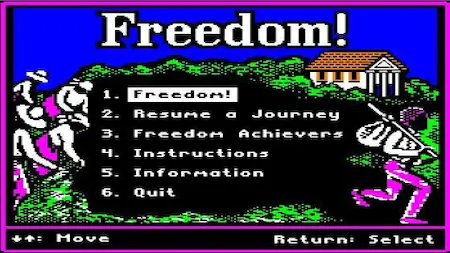
The game decides if your character can read, swim, etc., giving you different tools and challenges in each playthrough. Depending on how things went, you could reach freedom or see your character taken back into slavery in chains.
At this point, I imagine you’re thinking…well, actually, you could be thinking a whole lot of things, from “wtf how did I never hear of this?” to “ooooohhhhh I remember that weird, unsettling game.” Probably more of you are in the former camp, though, because this game flopped in a big, if unsurprising, way.
MECC—whose intentions across its entire range of games were quite good—repeatedly emphasized that the game should be used only as part of a larger curriculum to help students understand the dark but important history of American slavery. But how many schools do you think used it that way? Did your school use the Oregon Trail that way? Of course it didn’t. So they didn’t use Freedom! That way, either.
Instead, kids dealt with this difficult—and not always sensitively handled (imagine ‘You have died of dysentery’ applied to enslavement, with some historical racist language)—material more or less on their own at a computer in the back of the classroom…and then went home and told their parents about it.
Lawsuits were threatened. MECC tried to open a dialogue about altering the game to make it work better as a meaningful educational tool, but it was too late; the game was pulled from the market, and MECC asked schools to destroy all copies.
Learning from this experience, when they later developed Africa Trail, MECC focused on testing it first to present challenging racial and postcolonial themes more sensitively and effectively.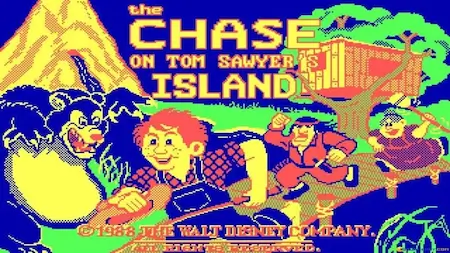
The Chase on Tom Sawyer’s Island was available on one of the classroom computers of my childhood; this was presumably based entirely on its name-checking of Mark Twain’s novel, because there was zero educational value – the game was a Pac-Man clone where you ran around island paths grabbing berries and avoiding ghosts, I mean Aunt Polly, Injun Joe, and a bear.
But putting aside its bizarre IP strategy, as a kid, I was fine having a Pac-Man clone smuggled into school as instructional material.
Additional weird trivia: while refreshing my memory of this game, I learned that it was not the only late 80s video game based on Mark Twain’s novel – there was also The Adventures of Tom Sawyer, a platformer in the early-Nintendo mold. This one, too, seemed to have no educational aspirations, presenting a dream sequence rather than engaging with the source material. Which is fine, I guess, but…why? Was all this just to get parents and schools to buy it? Why else would you skin a Pac-Man or platformer with the IP of a hundred-year-old humorous coming-of-age novel?