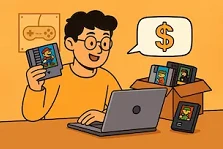
When you sell old video games, the biggest number isn’t always the best deal. A store credit offer depends on what you can buy with it. Cash offers can differ between buyers. Selling the games yourself means accounting for expenses and your time. Here’s how those options compare, starting with cash versus store credit.
- Store credit looks bigger on paper but can only be spent at the store that issued it — where prices are already marked up 30% to 40%.
- GameStop's cash offer on Pokémon LeafGreen: $10.50. The Old School Game Vault's cash offer for the same game: $58.26.
- We tested six retro games on both eStarland and The Old School Game Vault. eStarland paid $387.55 cash. We paid $458.96 for the same games.
- Compare a marketplace sale with a trade-in offer after subtracting selling expenses. Consider the time needed to list, pack, and deliver your games separately.
- The Old School Game Vault has been paying real cash for retro games since 2008 — no store credit, no membership required, no gimmicks.
The Table of Contents
Video Game Trade-In Cash vs Store Credit Compared
The Hidden Truth About Store Credit
After buying and selling games since 2008, one thing still surprises me — people accept store credit without checking what that credit actually buys them. The same store handing you $30 in credit is selling GoldenEye 007 at 40% above market value. You're not coming out ahead. You're just spending your own money back at inflated prices.
Store credit is a marketing tactic designed to keep your money within a single store. Before you accept that "bonus" credit, consider these facts:
- The Locked-In Loop: You can only use that credit at the retailer that issued it. This is true even if its prices are higher than others.
-
No End Dates: A 2025 study found that 47% of consumers never use store credit or gift cards before they expire. This means they give away their games for free.
- The Price Hike: Retailers raise prices on retro video games and accessories. They do this to balance out the "high" trade-in values they give.
Real Example: Pokémon LeafGreen Trade-In
To see how much the "credit trap" costs you, look at the current market offers for Pokémon LeafGreen (GBA):
- GameStop Cash Offer: $10.50
- GameStop Credit (with paid Pro membership): $16.50
- The Old School Game Vault Cash Offer: $58.26
We pay over five times GameStop’s cash offer. We don't need a paid subscription. There are no "gimmicks." We pay you in real-world currency that matches your game's true market value.
Choosing cash is only the first comparison. The next is how much each buyer offers for the same games. We compared a six-game collection to see how those cash offers differed.
eStarland vs The Old School Game Vault: Real Trade-In Totals
We tested both platforms using the same 6 retro games, all in used condition with no manuals or boxes. Here's how they stacked up in June 2025:
| Game Title | Platform | eStarland (Cash) | The Old School Game Vault (Cash) |
|---|---|---|---|
| EarthBound | SNES | $210.00 | $210.11 |
| Fire Emblem: Path of Radiance | GameCube | $83.25 | $123.00 |
| Persona: Shin Megami Tensei | PSP | $40.00 | $55.02 |
| Mario Party 5 | GameCube | $27.50 | $30.60 |
| Obscure: The Aftermath | PSP | $22.00 | $33.48 |
| Silent Hill: Homecoming | PS3 | $4.80 | $6.75 |
Total Cash Value:
- 🟥 eStarland: $387.55
- ✅ The Old School Game Vault: $458.96
Difference: That's $71.41 more in your pocket with The Old School Game Vault — no gimmicks, no restrictions.

eStarland Offer

The Old School Game Vault Offer
How Storefront Costs Affected My Offers
Online quotes are one option; taking your games to a local shop is another. Running a storefront taught me how operating costs can affect what a business can afford to offer.
I know this for a fact: years ago, I had a storefront on Belmont Ave in Chicago. I always had great foot traffic. Still, rent isn’t cheap at that location; insurance, parking, etc., all add up. Working exclusively online now gives me the ability to buy consoles at prices I couldn’t before with these expenses.
Selling Through Online Marketplaces
After comparing trade-in offers, you might wonder whether you could get more by selling directly to another collector. That’s where eBay and Facebook Marketplace come in. To compare that route with a buyback offer, look at what remains after expenses and how much work the sale requires.
Breaking Down a $50 Sale
If a site says your game is “worth” $50, you aren’t actually putting $50 in your pocket. You have to subtract the costs of doing the work yourself.
This example assumes a $50 total used to calculate fees, an illustrative fee of 13.6% plus $0.40, and $7.50 for shipping and materials. It is not a current platform fee schedule; actual fees depend on the platform, seller account, and transaction.
| Cost Category | Amount |
|---|---|
| Sale amount | $50.00 |
| Illustrative marketplace fee | −$7.20 |
| Shipping & materials | −$7.50 |
| Cash remaining before travel expenses | $35.30 |
Your time has value. If you value your time at $20 an hour, then 30 minutes of work costs you $10. This usually includes research, taking photos, editing, and writing a detailed description.
Subtracting that $10 time estimate and a separate $4.50 estimate for travel and logistics leaves $20.80 after those estimated costs. Your time is not a fee deducted from your payout.
A listing requires photos, accurate descriptions, condition notes, and, usually, a few buyer messages asking questions. Then you package the item, drop it at the post office, and wait for the payment to clear. For one or two high-value games, that tradeoff makes sense. For a collection of 40 loose cartridges, it starts to feel like a part-time job with variable hours. eBay rewards patience and effort.
Facebook Marketplace and Local Sales
Selling locally changes that calculation. An in-person handoff avoids postage, but you still have to find a buyer, agree on a price, and arrange the meeting.
You’re limited to local buyers, which immediately shrinks your pool. No-shows are common. Buyers expect to negotiate hard. For anything beyond common titles, you’re working with strangers who may or may not show up.
If you have time, patience, and a handful of high-value individual titles, eBay is worth the effort. A rare complete-in-box game with collector demand can sell for a premium you won't find anywhere else. That ceiling is real, but so is the work. Facebook Marketplace handles small, casual lots reasonably well when you want zero fees and don't mind local coordination, though it's better suited for common titles than anything with serious retro value.
What to Check Before Choosing a Buyer
If you decide a trade-in offer is worth the convenience, check the buyer’s terms before shipping. The quoted amount is one part of the decision; payment options, inspection, and returns matter too.
- Do they offer cash, store credit, or both? Understanding the payment methods can help you decide which best fits your preferences.
- What is the process for items that are not accepted? Some buyers return them, while others may not. Knowing the policy upfront helps set expectations.
- How long is the quoted offer valid? The validity period can affect your ability to prepare and ship your items at your own pace.
- Do they have experience authenticating retro games? For sellers with rare or valuable items, verification expertise may provide additional confidence in the transaction.
Selling to The Old School Game Vault
Here’s how our service fits that comparison:
The Old School Game Vault has been running an online mail-in buying service since 2008. Over 22,000 games, systems, and accessories are priced out for you to get instant trade-in prices for your items.
- The Old School Game Vault makes payments via PayPal, Zelle, Venmo, Apple Cash, business check, or Amazon Gift Card. Because its offers are not tied to store credit, the cash payout options are easier to compare directly against other buyers. All orders over $100 receive a free shipping label by email.
- You’ll get paid within 3 to 4 business days after we receive your order, including inspection and testing.
- If any of your items don’t meet our quality standards, you’ll be told and can choose to have those items sent back to you. See our rejection policy and shipping policy for the applicable terms and costs.
Compare the cash quotes you receive with what you expect to keep from selling the games yourself. If you’re considering store credit, check the price of what you actually want to buy. Then decide how much time and work you want to put into the sale.
Frequently Asked Questions
What are the best places to trade in video games for cash?
For the highest cash return on retro titles, specialist mail-in buyers like The Old School Game Vault consistently outpay general retailers. We paid $458.96 cash for six retro games that eStarland paid $387.55 for. GameStop's cash offers run 20-30% of market value. A specialist who prices by collector demand rather than barcode will always pay more.
Where can I trade in used video games for cash?
Options range from GameStop and local stores for instant but low cash, to eBay for the highest ceiling with the most effort. For collections and retro titles, a mail-in specialist like The Old School Game Vault gets you a real cash offer based on actual market value — no store credit, no membership required.
How do I get the most money when trading in used video games?
Get quotes from multiple sources before committing. Check PriceCharting for a baseline market value. Avoid store credit unless you plan to buy from that same store immediately — retailers mark prices up 30-40% to offset the credit bonus. For retro titles, a specialist buyer will recognize collector value that a general retailer won't.
Will GameStop give you cash for games?
Yes, but their cash offer is always significantly lower than their store credit offer. On Pokémon LeafGreen for GBA, GameStop's cash offer was $10.50. The Old School Game Vault paid $58.26 for the same game — no Pro membership required.
Who pays the most for used video games?
It depends on what you have. For rare or high-value retro titles, a specialist buyer who uses real market data pays the most. General recyclers and big-box retailers price by barcode and volume, not collector demand. The Old School Game Vault paid $458.96 cash for six retro games — $71.41 more than eStarland offered for the same titles.