Game Boy Advance games have been counterfeited for a long time, and I run into fakes regularly. Customers have told me they bought the game years ago in China, but I've also had people swear they bought it brand new from Walmart or GameStop. That tells you how deep this goes. Most major retailers simply don't have the means to spot these before they hit the shelf, which means fakes have been in the market for years.
- Label: Real cartridges have imprinted numbers stamped into the front label. Fakes have none or very faint markings.
- Nintendo Seal: Real cartridges have a clear sharp seal. Blurry or uneven fonts are a red flag.
- Circuit Board: Look for the MX chip. Authentic boards have it. Most fakes use different chips or omit it entirely.
- Battery Test: Real Pokémon Emerald, Ruby, and Sapphire boards have a CR1616 battery. Fakes replace it with a black epoxy blob.
- Shell: Real GBA shells have two square mold impressions inside the back and an imprinted rectangle behind the label on the front. Fakes skip both.
- Color: Emerald and Leaf Green are green, Sapphire is blue, Ruby and Fire Red are red-toned. Wrong color means fake.
- The Old School Game Vault has been buying and authenticating GBA games since 2008.
How to Spot Fake Pokémon GBA Games
The Table of Contents
Step 1: Label Inspection
- Real cartridges have imprinted numbers “stamped into” the front label, generally two characters like 11, 03, or 0B. Fakes usually don’t have these numbers, or they appear very faint or missing entirely.
- A real cartridge has a clear Nintendo Seal, easy-to-see imprinted numbers, and a crisp, sharp font on the label. If the font appears blurry, uneven, or inconsistent with known authentic labels, it’s likely a fake.
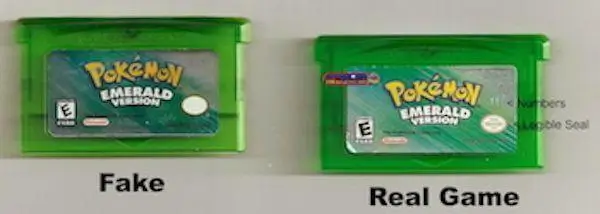
Pokemon Emerald cartridge real vs fake: label comparison showing the counterfeit (left) vs the authentic copy with imprint numbers (right).
Step 2: Cartridge Board Inspection
- Checking the cartridge’s internal circuit board and chips is a reliable way to see if a GBA game is real.
- Look for a chip labeled “MX” on the circuit board. Authentic cartridges have this chip, and counterfeiters often miss it. Many fakes use different chips or do not have the MX marking at all.
- Compare the design and size of the “Nintendo” font printed on the circuit board to a real one.

2A. The 'Battery' Test
- A real Pokémon Emerald board has an internal battery. Many fakes have a black circular blob of epoxy instead, which is a clear sign the game is not real.
- You need a Y-shaped screwdriver to open GBA games for inspection.
- This works great for Pokémon Emerald, Sapphire & Ruby versions as they all should have a CR1616-sized battery.
- Pokémon Leaf-Green and Fire-Red versions do not have a battery, so you can skip this step.
Step 3: Analyzing the Cartridge Shell
- Check if the cartridge shell is the right color. Real Pokémon Emerald shells are light green. If the color looks different, it might be a fake.
- Real cartridges have “Nintendo” stamped on the back shell. Make sure to check the spelling on both the back and front.
- Many fakes have spelling mistakes, which is a clear sign the cartridge is not genuine.
3A. Look At the Back Shell for Impressions
- Genuine Nintendo shells have two square mold impressions inside the back shell. Fakes usually do not have these.
- Look inside the shell for these molding stamps or markings to confirm it is real.

3B. Look At the Front Cartridge Shell
- Real GBA shells have an imprinted rectangle right behind the label area.
- Fake cartridges often use shells where you can see the label through the plastic.

Step 4: Check the Cartridge Color
Which Color Should Your Cartridge Be?

NTSC Pokémon cartridges have specific shell colors that help you tell if they’re real:
- Pokémon Leaf Green and Pokémon Emerald: green shell
- Pokémon Sapphire: blue shell
- Pokémon Ruby and Pokémon Fire Red: red-toned shells
- Pokémon Mystery Dungeon and Pokémon Pinball: gray shells
How to Spot Fake Pokémon GBA Games Video
 ▶
▶
Just like with every other counterfeit article I've written, the easiest way to verify a game is to open it. A photo of the board tells you more than anything on the outside ever will.
Frequently Asked Questions
How do I tell if my Pokémon Emerald is real?
Check the front label for imprinted stamped numbers and open the cartridge to look for a CR1616 battery. Fakes replace the battery with a black epoxy blob and often omit the MX chip on the circuit board.
Are there fake Pokémon GBA games?
Yes, GBA Pokémon titles have been counterfeited for decades and fakes regularly end up in retail stores. The easiest way to verify is to open the cartridge and inspect the board.
Do fake Pokémon Emerald games still work?
Some do and some don't. We've received fakes that loaded fine and others that failed immediately — there's no consistency because counterfeiters use whatever cheap components are available.
Do fake Pokémon Emerald cartridges have batteries?
No. Real Emerald, Ruby, and Sapphire boards have a CR1616 battery for the real-time clock. Fakes use a black epoxy blob in its place.
Is it illegal to sell fake Pokémon games?
Yes, selling counterfeit games violates trademark and copyright law regardless of whether the buyer knows they are fake. If you receive a game and suspect it is counterfeit, do not resell it.