Lorelei and the Laser Eyes, Simogo’s 2024 indie darling with a haunting, retro aesthetic, is a puzzle box filled with treasure.
Above all, it’s an amazing puzzle game. As long as you’re game for being stumped at times and willing to move on to different puzzles while you gather clues or let one simmer, playing it is a delight. In my 20+ hours, I got truly frustrated and stuck only a few times, and when I did, online hints showed me whether I needed to unlock other puzzles before I had the tools for this one or that I was overthinking things in the wrong direction.
The Table of Contents
An Intriguing Mystery Narrative
Lorelei is also a mystery story, and unlocking new pieces of its shadowy narrative provides an excellent reward for solving its puzzles, with a payoff at the finale that worked well for me (but no spoilers here). The story involves layers wrapped in layers, revealed piece by tantalizing piece, that do ultimately fit together.
A Stylish Homage to Gaming History
Finally, Lorelei is a stylish homage to a wide range of influences that its creators clearly loved. The game openly embraces these influences, even building the alternate-reality equivalent of a PS1 and a Game Boy into the main game for the protagonist to play, while still creating a fresh, rather than derivative, experience. In addition to games, Simogo’s inspiration board linked above lists books, music, films(/TV), computer graphics, style, and places, and all of them are worth diving into. But this is a game blog, so I’m going to geek out on the game influences, because when you play Lorelei you can’t help but want to replay—or newly discover the classic games it was inspired by.
Resident Evil and the Puzzle Mansion Legacy
To me, Lorelei's clearest influence is the original 1996 Resident Evil. Both games take place in an eerie, isolated, almost empty mansion that you must unlock room by room. Lorelei’s lo-fi graphics add to the connection, and when you play the in-game ~PS1, the reference becomes unmistakable. It’s cool to see the puzzle-mansion aspect of Resident Evil separated from the survival-horror shooter elements; it emphasizes how much that game benefited from the quieter elements of its fantastic design.
Exploring Lorelei’s mansion is addicting, and it is well designed enough that it’s rarely too frustrating to traverse the place or to manage inventory – both nice quality-of-life improvements over RE. The Silent Hill series also surfaces in the inspiration list, through Silent Hill 4: The Room (PS2, Xbox), whose locked-room-traversal features and plot turns make it the closest fit for Lorelei’s mansion puzzling.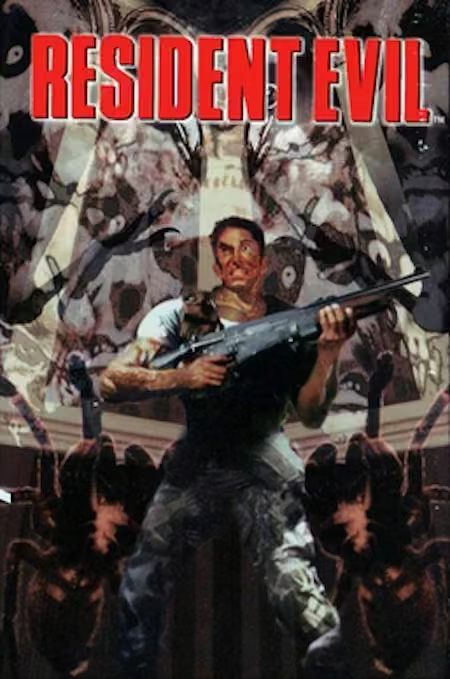
European Nostalgia and Professor Layton
Lorelei replaces the violent confrontations of the horror shooter with the melancholy grandeur of a faded Europe, looking back to the art, architecture, and technology of the mid-19th and mid-20th centuries and having the player navigate those worlds and histories instead of a zombie menace. This ties it to another key influence, Professor Layton, which shares its focus on puzzles, as well as its bittersweet European nostalgia and deceptively dark storytelling.
The Zero Escape Series and Dark Twists
These elements – puzzles, locked rooms, and dark, horror-adjacent narrative – come together in another set of Lorelei’s influences. First is 999: Nine Hours, Nine Persons, Nine Doors (DS, 2009), whose sequels, Zero Escape: Virtue’s Last Reward and Zero Time Dilemma (3DS, 2012 and 2016), I also highly recommend. These Zero Escape games combine room-by-room exploration and puzzle-solving with periodic violent, bloody shock cuts and narrative twists, much like some of Lorelei's surprising turns. Lorelei, though, uses its black, white, and red color palette to present highly stylized rather than realistic representations of the aftermath of violence.
Another Code: A Hidden Gem
Another spooky mansion puzzle game listed among Lorelei’s influences was new to me: Another Code: Two Memories (DS, 2005, known as Trace Memory in North America). The art looks familiar, but I never played it when it or its sequel, Another Code: R – A Journey into Lost Memories (Wii, 2009), came out. I definitely want to go back and play them now, though, due to the mix of elements they share with Lorelei and because I’m a sucker for games that do creative things with the DS and the Wii’s unique screen, mic, or motion-control capabilities like these apparently do, even if the puzzles aren’t supposed to be quite as engrossing as the titans of the genre.
Surprising Inspiration: Link’s Awakening
Before I get to the oldest influence, I’ll touch on the most surprising: The Legend of Zelda: Link’s Awakening (1993, Game Boy). On the surface, these games feel worlds apart. But on reflection, the connections are there: less in gameplay than in narrative frames (again, no spoilers here) and details such as an enigmatic owl guide.
The Oldest Influence: Mystery House
Finally, we come to the oldest of old-school influences: Mystery House, the first-ever “graphical adventure” game, released in 1980 by On-Line Systems (not even known as Sierra On-Line yet). These games, separated by more than 40 years, are strongly connected by Mystery House's stark, black-and-white line-drawing graphics and the core concept of exploring, well, a mystery house. The visual homage to one of the oldest graphics-based computer games also hints at why Lorelei’s influence-heavy world works so well.
Memory, Influence, and Legacy
Lorelei and the Laser Eyes is a game about memory, and the ways we relive and work through memories all our lives in our heads, in the spaces we traverse, and in our relationships. As a game, Lorelei explores this with its story and also by playing with decades of influences, reminding players of their own experiences with those earlier games. Visually, Lorelei makes direct references to earlier games while also exploring the layering of experience and memory through its disorienting visual technique, where a second image always floats restlessly beneath the main layer. Narrative, gameplay, graphics: all these elements are deeply layered with influences and work together to create a puzzle-box memory house that is a joy to unravel. And once you’re done, you can make your way along the web of influences to revisit old favorites or try out a classic game that may still be new to you.