In the beginning, video games were not meant to be completed. Do you “complete” soccer? Games were played in an arcade, a quarter at a time. You would complete a match of Computer Space (1971) or Pong (1972), and then you or someone else would start the next round.
The Table of Contents
The original Space Invaders (1978) just looped waves of enemies at you until you lost. “Have you played a lot of Pong?” someone might ask, trying to gauge how skilled you were at it.
The Rise of Game Completion
And then came games like Donkey Kong (1981) and Mario Bros. (1983), which, with enough skill or quarters, could be beaten. These games had a destination with a programmed body of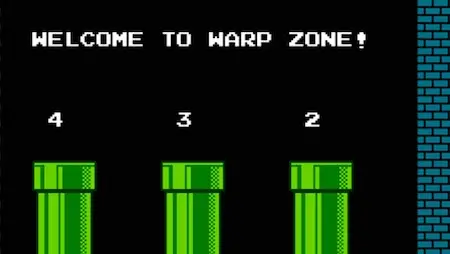 gameplay experiences along the path to it. “How long,” one could ask, “did it take you to beat that game?”
Branching Paths and Side Quests
Then, games came home on consoles. Super Mario Bros. (1985) hid inter-level warp pipes at the end of level 1-2, and now the question “how long to beat” depended not only on how fast you were, but also on how many levels you chose to complete en route to the final showdown.
- Metroid (1986) offered non-linear platforming, which, while mostly required for game progression, opened the door to the modern possibilities of optional material (you don’t have to get all the missile upgrades to complete the game).
- Final Fantasy (1987) offered side quests (take the Rat Tail to Bahamut to upgrade character classes; take Adamantine to the smith to forge Excalibur). “How much,” one could now ask, “of that game did you beat?”
Length Limits and Technical Constraints
From the 80s into the early 2000s, technical limitations and the gradual growth of the gaming industry imposed practical limits on the length of pre-designed (as opposed to procedurally generated) games. Until it became easy to save games or put consoles to sleep, most games needed to be playable in one (long) sitting (though you could leave a console on overnight in a pinch).
What you could fit on a Nintendo cartridge was the limit for most console game design. Zelda had the clout to experiment with 2001’s multi-cartridge Oracle of Seasons and Oracle of Ages, where completion of one gave you a password to continue your game into the other, but this was the exception, not the rule.
The CD-ROM Revolution and Industry Growth
The advent of CD-ROM-based console gaming in the PlayStation era made possible multi-disc games like Final Fantasy VII. Gaming was also coming of age as an industry rivaling Hollywood.
Sometime in the 2010s, video gaming took the financial lead from Hollywood, and in 2024, video games grossed over $180 billion, more, the Wall Street Journal notes, than Hollywood, Netflix, and the NFL combined (though if you include all streaming revenues, games fall back behind).
RPG Expansion in the 90s
With save games and increasing file sizes, RPGs could stretch their legs from the 90s onward. In 1990, Final Fantasy III, the average How Long to Beat (HLTB) playthrough time was 17-18 hours, and the average ‘main quest only’ time was 16.
By the middle of the decade, these times had doubled or tripled. The average and ‘main quest’ times for:
- Final Fantasy VI was 40 and 33 hours in 1994.
- 1995’s Dragon Quest VI was similar.
- Final Fantasy VII (1997) maintained this scope despite the transition to 3D graphics, with average/main quest times of 47 and 36 hours, respectively.
The 2000s and the Attention Economy
But in 2000-01, we saw a sign of things to come when Dragon Quest VII clocked in at 2-3 times that length, with an average playthrough of 130 hours and a ‘main quest’ average of 105 hours (the 2013 3DS release played shorter at 85/75). Games were once again expanding both how much you could do and how much you had to do to complete them. In the coming years, the attention economy roared to life, and gaming was not immune.
Gaming-as-service, side quest/open-world bloat, microtransactions, and DLC were all symptoms of the commercial imperative to keep gamers playing and spending, even at the expense of the experience. Corporate publishers pressured designers to twist games to fit these financial models. But even standalone purchases like single-player RPGs bought into the larger cultural idea that more game was better game.
Are RPGs Actually Getting Longer?
Brad Edwards did an interesting analysis (of HLTB playthrough data) of games from 2008 to 2022 to ask if the top 5 bestselling games of each year were getting longer or shorter. His report on RPGs (as defined by him) found the following information:
The bestsellers list from 2009 to 2016, with an average of 26.4 hours played.
- The Elder Scrolls: Skyrim
- Pokémon Platinum
- Destiny
- Fallout 4
- The Division
The bestsellers list between 2017 and 2022, with an average of 36.4 hours played.
- The Legend of Zelda: Breath of the Wild
- Destiny 2
- Borderlands 3
- Assassin’s Creed: Valhalla
- Pokémon: Brilliant Diamond and Shining Pearl
- Elden Ring
- God of War: Ragnarok
There’s plenty to quibble with here: what’s an RPG, what about main + sides times, what about a larger sample size of prominent RPGs? Take Breath of the Wild, for instance – its ‘main quest only’ time (that Edwards uses) is 50 hours, but HLTB’s average of all playthroughs is 92 hours, much closer to the ‘main + sides’ average of 98. Still, Edwards’ data supports the idea that, from 2008 to 2022, the minimum time required to complete an RPG likely increased.
Comparing Final Fantasy VII Across Generations
As a final example, let’s compare FFVII Remake (2020) and its sequel FFVII Rebirth (2024) to the 1997 original. Final Fantasy VII’s average and main quest completion times were 47 and 36 hours. Remake has average times of 42 and 32 hours (for a section of the original that I completed in 6 hours).
In my opinion, it worked pretty well as a classic 45-hour RPG experience – roughly as long as playing the original game. The more controversial, open-world-heavy (-bloated?) Rebirth, on the other hand, has average times of 90 and 48 hours.
In other words, you have to spend 12 more hours on the main quest than in the original, and the average explorer of side content spent twice as much time as in the original (90 vs 47 hours). The section of the original game that aligns with Rebirth took about 15-25 hours to complete.
The Modern Gamer’s Dilemma
I’ll end with a couple of thoughts, one familiar and one a bit less discussed. First, as gamers get older, many of us have less time for today’s longer playthroughs amid other obligations, so frustration mounts when a shorter experience isn’t possible – driving us, in many cases, back to retro games that offer satisfying experiences in less time.
I also want to point out that the main quest playthrough time of Rebirth isn’t that different from the average playthrough of the original Final Fantasy VII (48 vs 47 hours). So part of what’s frustrating busy gamers like me, I think, is that in the attention economy of our notification-driven world, it’s hard for us to walk away from the side quests markers and just do the main quest.
If we could, we might have a more satisfying experience. But our world has trained us to want to check the next box, get the next upgrade, especially when, in games, that’s layered over the more innocent desire to explore the next horizon and pursue the next mystery. If we can ignore the attention economy's siren call to more, more, more, then we might find our way to modern experiences that better resemble the time-respecting satisfactions of the retro games we love.