Advance Wars for the Game Boy Advance has an unusual release history. Originally intended as a Japanese exclusive because Nintendo didn't think Westerners would be into turn-based strategy (TBS), this classic game was eventually released first in North America…on September 10, 2001.
A Tactical Throwback Review Advance Wars
The Table of Contents
In the aftermath of the next day's terrorist attacks, European and Japanese releases were postponed. Advance Wars launched in Europe a few months later, in January of '02, but the game, originally meant to be Japanese-only, didn't come out in Japan at all for another three years, first appearing in a compilation with Advance Wars 2 in November 2004.
The Famicom Wars Legacy
Advance Wars was part of a larger series already established in Japan, known as Famicom Wars (Famicom being the Japanese name for the original Nintendo Entertainment System). The overall series, now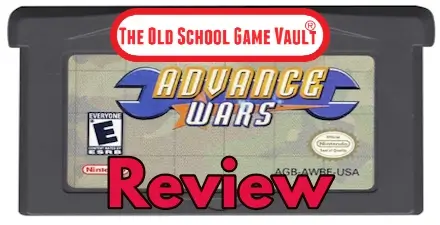 sometimes called Nintendo Wars, includes 12 titles (the first half of which were Japanese exclusives) between 1988 and 2008, but has been dark for the 16+ years since Advance Wars: Days of Ruin released for the DS.
The ongoing success of Fire Emblem, (Nintendo-run) developer Intelligent Systems' other turn-based strategy series, suggests that there's still an audience, though, so they haven't ruled out keeping Advance Wars alive. Today, though, we're going to take a look at the game that brought the series to the West and had a huge impact on the popularity of turn-based strategy here: 2001's Advance Wars for GBA.
Advance Wars Story
The nation of Orange Star is at war with its neighbor, Blue Moon, which launched a surprise invasion. Later conflicts arise with Green Earth and Yellow Comet, also apparently over mysterious misunderstandings.
spoilers Eventually, it is revealed that Sturm, the commander of the Black Hole army, has been using a lookalike of Orange Star Commanding Officer (CO) Andy to attack the other countries, leading them to believe Orange Star is the aggressor, so as to weaken them all before Black Hole steps in to conquer. Combining their powers and COs, the four countries are able to force Sturm and Black Hole to withdraw.
Though war-themed, the tone is breezy, unproblematic, and focused on larger-than-life CO personalities (often played for comedy) and the mystery of misunderstandings about international aggression. The best word to describe the story of Advance Wars is "fun."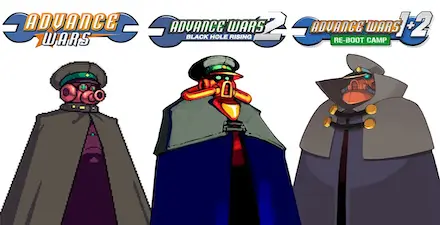
Graphics and Sound
Advance Wars features an iconic cartoonish graphical style that makes it one of the most accessible TBS series—and a great starter game for newbies. By deemphasizing the violence in the story and graphics, Advance Wars offered a game that kids could enjoy, and parents could feel okay buying for them. The primary colors of the warring nations are reflected in a bright, cheery palette for the game, reinforcing the idea that it's all about fun.
The soundtrack does its part for the joint effort, as well. It's upbeat and has strong drum beats. While it's not very memorable, it's also not annoying for a 2001 GBA game. The music is not why you play this game, but neither is it a reason to stay away.
The Gameplay - Fun Meets Strategy
Which brings us to the heart of the matter: Advance Wars has terrific gameplay. When first released, many devoted gamers worried that the cartoonish design meant the game would be pretty lightweight, but Intelligent Systems actually put a robust, challenging, colorful hood on it. The developer's stroke of genius was committing to the idea that a TBS game didn't have to be easy to be accessible.
Innovative Tutorial Design
Advance Wars opens with simple foundational mechanics and a long, while-you-play tutorial (groundbreaking at the time) to ease players into more complex systems bit by bit without having to pore over a manual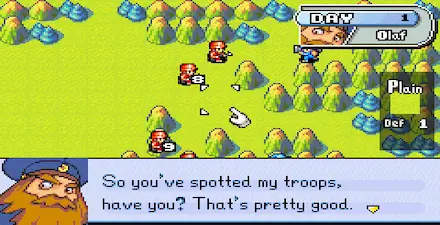 for hours before firing up the game itself. It's something we've come to expect from games today, but in 2001, as retro gamers know, this was quite innovative, and meant that Advance Wars reached a much wider young audience than it otherwise would have (alongside adult gamers).
Advance Wars is easy to learn and hard to master. To win the later levels, you have to really know your stuff, or you find yourself, as often as not, in an endless war of attrition, throwing unit after unit against your enemy while gaining or losing ground with agonizing slowness.
How Advance Wars Differs From Fire Emblem
Luckily, this gameplay is extremely fun, so the occasional endless battle is rarely enough to put you off continuing to play. Unlike Fire Emblem (2003), Intelligent Systems' other classic TBS series, the fighting units in Advance Wars are not individual characters with their own storylines and relationships, and they face the specter of permadeath every time they take the battlefield.
No, in Advance Wars, the characters are the off-field COs, and the on-field units are simply land, sea, and air units that you can throw at the enemy tactically, expecting certain losses. This makes Advance Wars a totally different experience from Fire Emblem. Both are great, but the differences ensure that each has its own flavor and strategy.
Playing Advance Wars, I can take bigger risks with units because if they die, so what? The mechanics are built for units to take losses (incrementally from a starting strength of 10), so determining what losses are acceptable and advisable and how to use terrain advantage to outwit an evenly matched foe are enormously entertaining challenges that stay fresh through the game's excellent level designs.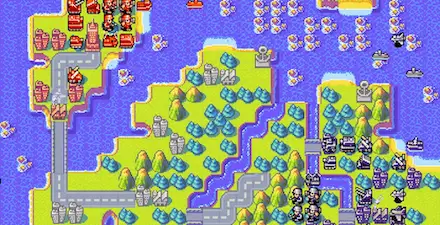
Strategic Depth
The battlefields are strewn with towns and bases that must be captured (and recaptured) to serve as staging grounds for further battles, adding another layer of strategy that differentiates this series from Fire Emblem.
All in all, where Fire Emblem makes you feel like an adventurer with a team of skilled fighters at your disposal, Advance Wars does an excellent job making you feel like a general who is going to take some losses en route to a hard-fought victory.
The Wrap Up:
I have no qualms recommending Advance Wars to any TBS fan. Though now over 20 years old, the game holds up fantastically well to retro play (and is available in its original GBA form, which I played). Previously, the game was also accessible via the Wii U Virtual Console. However, since the Wii U was discontinued in 2017 and its Virtual Console services have now ended, it is no longer possible to purchase or download new Virtual Console titles on that platform.
The multiplayer modes (on GBA at least) are probably not going to give you much mileage unless you have a group of dedicated retro gamers, and the Wii U version didn't support multiplayer except in a pass-the-GamePad-back-and-forth two-player local style, which was all right for TBS. Nevertheless, the single-player experience of Advance Wars remains terrific, another example of Nintendo's excellent gameplay design that has endured the test of time.
The Verdict
We rate Advance Wars a 9.0 out of 10 — a brilliant ★★★★½ on our retro review scale
Would I recommend it?
Yes, Advance Wars is a great pick for seasoned retro gamers, TBS fans looking for a classic experience, or kids ready for a challenging but accessible game more involved than Super Mario Bros. and other youth-friendly titles.
Would I replay it?
Yes, Whether it's a replay or your first time, you won't go wrong with Advance Wars.
Update: A Modern Remake Changed Everything
In April 2023, Nintendo launched Advance Wars 1+2: Re-Boot Camp for Nintendo Switch. This is a complete remake of the first two games. It features updated graphics, better quality of life, and online multiplayer. This is now the definitive way to play Advance Wars. It solves the multiplayer accessibility issue I mentioned in 2015. The original GBA version is a great retro game. If you want great gameplay with modern features, choose the Switch version.
We buy almost all of the Nintendo Game Boy Advance library. If you want to trade in any old games, we pay cash at competitive prices.