Final Fantasy IV Advance was released for the Game Boy Advance in 2005. The game was first released in the U.S. in 1991 as Final Fantasy II for the SNES. It’s the oldest Final Fantasy game I’ve played.
Trying FFIV for the first time today might feel a bit outdated. The game has changed a lot, with 3D graphics on DS, mobile, and PC, and updated 2D graphics for the PSP. These versions are now considered retro, too. There are plenty of re-releases and digital versions on modern systems. The original 2D sprite version looks old, but it’s still worth playing. Fans of the series or RPG history will enjoy it, and even after 30 years, it’s still a lot of fun.
The Table of Contents
Story and Characters
Fans of modern RPG storytelling owe a debt of gratitude to Final Fantasy IV. FFI and FFIII had bare-bones stories; the player-characters didn’t even have names! And while FFII’s story was a bit more elaborate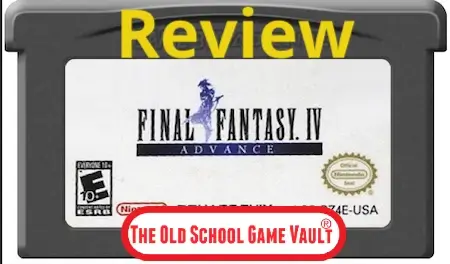 (named ominous empire), it was still quite simple by today’s standards, and the game featured probably the least popular (and least RPG-like) gameplay of any early FF title.
Which brings us to FFIV. This story feels like a Final Fantasy story, even for someone who first started playing the series in the PS1 era with Final Fantasy VII.
The sizeable array of player characters and nemeses has relatively developed personalities and relationships. The story features surprising (and occasionally ridiculous) twists and explores themes of loss, betrayal, cooperation, sacrifice, redemption, and an internal battle between good and evil in each of us.
The GBA version improves on the rather sloppy localization of the North American SNES version (called Final Fantasy II). I would definitely recommend FFIV Advance over the SNES’s FFII for anyone looking for an old-school (as opposed to 3D graphics) version of the game.
The story is not without its faults.
The number of characters who apparently died, usually by sacrificing themselves for the group, and then were revealed as really still alive later on, was farcical: Edward, Yang, Porum, Palo, and Cid. You could arguably add every single protagonist in the final battle to this list (wiped out, then brought back by the faith and strength of their absent friends), but since that happens right away.
It’s not in the same category for me as the many, MANY situations in which FFIV gives you a heroic death scene, then several hours later, it's like “Oh yeah, that wasn’t for real. I know he jumped out of an airship strapped to a bomb that then exploded, but he didn’t die from that. He just got a little hurt.” The game undermines some of its own emotional power in these scenes.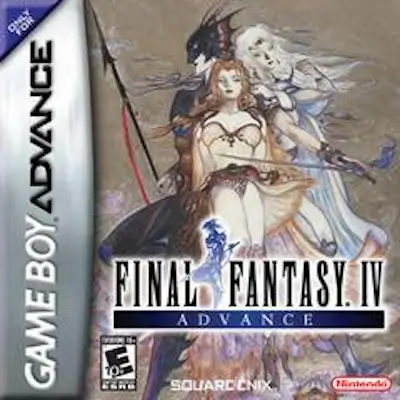
More generally, the story and characters aren’t as fully developed as their successors in later FF games, making this story less rewarding to return to than, say, the several games starting with FFVI. But as I said above, this game is the narrative foundation for all that came after, so even when it’s a bit rocky in its own right, it’s interesting to see where true Final Fantasy storytelling got started.
Music and Sound - Nobuo Uematsu’s Work
It should come as no surprise that Final Fantasy IV features an excellent Nobuo Uematsu soundtrack.
Many of the core themes are here already, and the game features several good exclusive tracks as well. It’s not one of my all-time favorite FF soundtracks, but it’s definitely a plus rather than a minus, and it’s impressive to see what Uematsu was already able to do in 1991 within the aural limitations of the SNES hardware.
As I’ve mentioned elsewhere [Telling a Compelling Story with in-game Music], FFVII was the game that got me to start taking game music seriously. If I’d have played FFIV when it came out, that might have done the trick years earlier.
Graphics
FFIV’s graphics are what you’d expect from SNES (or, in the case of FFIV Advance, GBA) sprite technology. Not terrific, not awful.
I didn’t dislike looking at the game, but the graphics aren’t especially rewarding by today’s standards. FFVI, made for the same system, clearly makes a more sophisticated use of the same tech limitations and holds up better graphically as a result.
FFIV’s graphics are neither a plus nor a minus for me, with the nostalgia factor and the lack of any major eyesores balancing out the fact that it’s not exactly pretty by today’s standards.
Gameplay And Story
Overall, I’d have to rate FFIV’s gameplay as just barely worth returning to today. The game is undeniably rudimentary compared to later games. But, like the storytelling, it sets the stage for what makes those games even better. Final Fantasy VI Advance offers a richer experience. It shows how the series evolved. This is interesting. I’ll share more details in my review of FFVI Advance, where I’ll dive into its improvements.
FFIV introduced the iconic Active Time Battle (ATB) system, which sped up battle and added an often illusory but exciting sense that you needed to hurry and make decisions on the fly.
The core of FF turn-based combat is here, with (uncustomizable) character classes and special abilities, up to five characters in a combat party (and twelve playable characters in total). The other FF/RPG staples, like a world map, towns, dungeons, airships, and summons/eidolons, are all present and enjoyable.
The Grinding Problem
On the minus side, I set down the game for months on one occasion when, maybe two-thirds of the way through the game, I reached a mandatory boss (Asura and Leviathan) that I was woefully underprepared to defeat.
I wound up grinding for hours before I could get back to the story, and it left a bad taste in my mouth. After that, though I didn’t have to completely pause my progression for long grinding sessions again, I had less patience with the many hours of battles still left.
What Actually Works
On the plus side, I enjoyed how the game would force player characters in and out of your party, so you had to keep tweaking your strategy based on the characters and skills currently available.
That kept the battles relatively fresh through most of the game (my complaint above about my one soul-crushing grinding session notwithstanding). Also, the fact that the game was picking your party combo for you meant no anxiety about having picked a suboptimal team.
I also enjoyed the variety of settings (which, to avoid spoilers, I’ll just refer to as Over, Under, and Way Over), bosses, and even vehicles (which include airships, hovercraft, airships that can CARRY hovercraft, and, shall we say, a super airship).
Playing the game today, I sometimes wish save points were more plentiful, but on the other hand, there was some enjoyable tension in trying to forge through a dungeon without running out of MP (and then health) before I could reach the next save point, so those two balance each other out for me.
I was disappointed early on by the lack of side quests, but the latter half of the game opened up more, with optional dungeons featuring nice armor and summons and such. Finally, FFIV Advance even offers an early version of New Game Plus to players hungry for more, with a new dungeon unlocking after you beat the game.
And there’s this weird motif where a bunch of NPCs you talk to just dance a bunch. What’s that about?
Final Thoughts And Replayability
I’m glad I picked up FFIV when I did, even if it was long after its original release.
It felt slightly long at 30 hours (in my main + extras playthrough), largely due to that one frustrating grinding session that probably added 4-5 maddening hours to my overall playtime (don't be like me: try to be at least in the upper 40s if not level 50 by the time you get to the Town of the Summonses).
All aspects of the game, from story and gameplay to sound and graphics, feel a bit dated, but they’re all really well designed. So despite the fact that later FF games have clearly surpassed this one, it’s still a rewarding experience, and there’s a tangible sense of playing RPG history.
For players seeking a taste of the action with more modern graphics, voice acting, added minigames, and other modernizing touches, there are DS, mobile, and PC versions, as well as digital re-releases for modern systems. The mobile versions (at least) even offer an Easy mode for those who want to experience it without being slowed down too much by combat.
Regardless of which version you play, FFIV is a game that has stood the test of time and is worth a look if you like the genre and have the patience for an older-style RPG.
The Verdict
We rate: Final Fantasy IV Advance a 7.9/10 — a ★★★★☆ on our retro review scale.
Would I recommend it?
To an RPG aficionado, yes. Choose the form of your destruction: there are lots of versions of this game, so pick the one you think you’d like best. Casual RPG players might find this too outdated to fully enjoy, though the updated versions might be fun even for more casual fans.
If you’re curious about tactical RPGs, check out my thoughts on Final Fantasy Tactics: War of the Lions. I also explain why I stopped playing.
Would I replay it?
Probably not again, but I might play the sequels: FFIV: Interlude and FFIV: The After Years.
The Collector’s Perspective:
If you still have the original box and manual for the GBA version, you can expect 146% more than a loose cartridge. The SNES version of Final Fantasy II (Final Fantasy IV) is much pricier. A complete copy, with box, manual, and inserts, sells for 392% more than the loose cartridge. The original Super Nintendo version is worth much more than the Game Boy Advance remake.
We buy both Super Nintendo and Game Boy Advance libraries. If you want to trade in any old games, we pay cash at competitive prices.